Blown Away – An Almost Olympic Disaster

Blown Away – An Almost Olympic Disaster

Still considered one of the top ten best Olympic opening ceremonies of all time, the Calgary Winter Games were officially opened on February 13, 1988. Not only are the ’88 games emblazoned in our memory for the heroic ski jumper Eddie “The Eagle” Edwards, not to mention the début of the Jamaican national bobsled team, but the ’88 games were also the most expensive Olympic games ever held at that time. The opening ceremonies alone came with a 10-million-dollar price tag, but long before the age of LED lights, drones and augmented realities, this ceremony relied on more traditional methods of entertainment. The 60,000 spectators crammed in McMahon Stadium each donned coloured ponchos to create a stadium-wide image for the two billion people watching from home. With upwards of six thousand performers, one thousand pigeons, hundreds of horses and thousands of balloons, the opening ceremonies were a joyous and colourful celebration.

Every Olympic opening is leading to that fateful moment when the cauldron is finally lit with the Olympic flame officially starting the games. For this memorable moment, the cauldron was placed atop a long staircase and a giant tepee structure was built aloft as a tribute to Canada’s indigenous heritage. Atop this tepee structure were wire rope hoists, connected to banners below that would be risen to form the full tepee at the moment the cauldron was set alight.

And that is how our Kristian Electric team found themselves at the 1988 Opening Ceremony. Hired to run the rigging required to bring up the tepee, they stood on the scaffold deck next to the controls, patiently awaiting their moment.

And then there was the wind.

Chinook winds are no stranger to the Calgary area. They didn’t want to miss out on the celebration. As 7-year-old Robyn Perry, a local seventh-grade student and figure skater, lit the cauldron, our Kristian workers began to raise the banners when the wind arrived.

“The structure started to shake violently. The wind had caught the curtains about halfway up,” remembers Dean Gjertsen, one of the Kristian workers on site that day. “The scaffolding started shaking violently too. Five of us dove off the scaffold and onto the red and white club roof!”

With gusts that reached upwards of 74 kilometres an hour, the wind was using the raising banners as sails… causing the tepee to shudder. Just as the job appeared to be heading south, the crowd was distracted by the Snowbird military aerobatic flyover and the resulting echoing sound of church bells and sirens that rang through the city of Calgary.

Seizing the opportunity, the Kristian team quickly lowered the banners and discovered that wind had caused the large ground screws securing the tepee to start pulling out of the ground.

“We were fortunate the jets distracted the crowds,” says Gjertsen. “It would have been a disaster with all the athletes and kids on the playing field below.”

After the ‘88 Olympic Games wrapped up, the tepee was moved to Medicine Hat, Alberta where it was rechristened the Sammis Tepee. With the addition of more structural elements in 1991 to turn the temporary structure into a permanent monument, the Sammis Tepee now stands in full glory above the scenic Seven Persons coulee. Today the Sammis Tepee is a popular roadside attraction, even christened the World’s Largest Tepee! With a foundation weight of 800 metric tons and nearly a thousand bolts holding the structure together, it is safe to say that this tepee isn’t going anywhere.

Dixxon at Kristian: Built for Work. Styled for Life.

When it comes to workwear, most people settle for “good enough.” But anyone who’s slipped into a Dixxon flannel knows there’s nothing “good enough” about it — it’s built different. At Kristian Electric, we’ve added DIXXON to our shelves to give welders, crane techs,...

Miller Build with Blue Is Back for 2026 — And It’s Bigger, Smarter, and Built for Real‑World Welding

Alright, let’s be real for a second. Winter is usually the season where welding projects slow down, budgets tighten up, and everyone starts putting off equipment upgrades. That’s exactly why Miller Build with Blue exists — and Build with Blue 2026 is shaping up to be...

Overhead Crane Service & Sales in Alberta & Saskatchewan | Kristian Electric

Authorized Hoist & Crane Service Depot — Calgary, Edmonton & Saskatoon Kristian Electric Ltd. is a Canadian leader in overhead crane service, hoist repair, CSA-compliant inspections, and crane system sales. With full-service branches in Calgary, Edmonton, and...

SHORT CUT – Hypertherm Plasma Gouging

SHORT CUT – Hypertherm Plasma Gouging

What is gouging?

In the maintenance and repair industry, welds are often in need of replacement if determined to be worn or defective. Metal gouging and/or backgouging is the process of removing old welds or base metals to restore the weld surface. Gouging is also a popular process used in foundries to remove defects from castings.

Gouging can be achieved through mechanical processes such as grinding, hand milling, routing and chipping and oxyfuel, the latter of which can only be used on carbon steels. Out of the many processes, traditionally the most popular choice is air carbon arc gouging.

Carbon arc gouging uses a carbon/graphite electrode, compressed air, and a power source. The electric arc between the electrode and work piece cuts and melts the metal, while the high velocity air stream blows away the molten metal to leave a clean groove. Though carbon arc gouging is a popular choice, it does come with some disadvantages and safety issues.

What is plasma gouging?

Much like plasma cutting, plasma gouging uses a plasma arc between the torch and workpiece to melt the metal, while utilizing the gas jet to blow it away. This is achieved with specially designed consumables for the plasma cutting system that produce a wider arc. When the plasma torch is held at an angle, only some of the material is blown away. Plasma gouging works on any conductive metal, including mild steel, stainless steel, aluminum, and copper.

What makes plasma gouging superior to carbon arc gouging?

Cleaner – Carbon arc gouging, especially with poorly practice or insufficient air flow, results in contamination within the side walls of the metal which may lead to metallurgical issues. Plasma gouging reduces contamination of the workpiece and minimizes the spread of debris and pollutants at the worksite.

Automation – Powermax plasma cutting systems from Hypertherm allow the user to gouge both freehand or with a track cutter, and can even be made fully automatable with a CNC cutting table. These features ensure clean and consistent gouge profiles every time.

Spot Weld Removal – The Powermax45 plasma system is a fast and cost-effective solution for spot weld removal. Using the precision-gouging consumables and operating at 10-25 Amp output current not only allows the operator better visibility but increases precision to protect the base metal with less fatigue on the wrists, arms, and shoulders.

Safer – As carbon arc gouging pushes the molten metal away with compressed air, fine droplets are created when the metal reacts with the air, resulting in a high level of fumes during the process. Plasma gouging uses gas to push the molten metal away, which generates less metal vaporization and reduces metallic vapour in the work area.

Faster – With the less time spent on secondary grinding work and overall quicker operating speeds, plasma gouging saves time and increases efficiency.

Quieter – Although both processes tend to be on the louder side, plasma gouging is 5-10 decibels quieter than carbon arc; reducing risk of possible hearing loss and communication interference.

Powermax Family

The Powermax family from Hypertherm is a line of portable cutting and gouging systems that are the ideal choice for cutting and gouging of any electrically-conductive metal. Six out the seven machines in the Powermax line offer dedicated gouging operation modes that adjust the amount of pressure traveling to the torch. Hypertherm also offers specialized gouging consumables in four tiers depending on the end user’s needs.


Consumables


Max Control Gouging Consumables

Max control shield is designed for slower rates of metal removal.

– Better control over amount of metal to be removed

– Shallow gouge profile creation

– Light washing capability


Max Removal Gouging Consumables

Ideal for experienced operators looking for faster rates of metal removal.

– Aggressive metal removal

– Deep gouge profile creation

– Extreme metal washing capability


HyAccess Extended Consumables

Designed for cutting or gouging in hard-to-reach places.

– Extended reach

– Improved visibility

– Easy to use


Precision Gouging

Ideal for precise applications, such as spot weld removal.

– Designed to operate at low output current (10-25A)

– Ultra low-density arc for better visibility of defect removal

– Precision performance to protect the base material


Learn more about Hypertherm plasma gouging here.

Dixxon at Kristian: Built for Work. Styled for Life.

When it comes to workwear, most people settle for “good enough.” But anyone who’s slipped into a Dixxon flannel knows there’s nothing “good enough” about it — it’s built different. At Kristian Electric, we’ve added DIXXON to our shelves to give welders, crane techs,...

Miller Build with Blue Is Back for 2026 — And It’s Bigger, Smarter, and Built for Real‑World Welding

Alright, let’s be real for a second. Winter is usually the season where welding projects slow down, budgets tighten up, and everyone starts putting off equipment upgrades. That’s exactly why Miller Build with Blue exists — and Build with Blue 2026 is shaping up to be...

Overhead Crane Service & Sales in Alberta & Saskatchewan | Kristian Electric

Authorized Hoist & Crane Service Depot — Calgary, Edmonton & Saskatoon Kristian Electric Ltd. is a Canadian leader in overhead crane service, hoist repair, CSA-compliant inspections, and crane system sales. With full-service branches in Calgary, Edmonton, and...

Give Peas A Chance – A Bulk Loading System

Give Peas A Chance – A Bulk Loading System

Lovingly Made Ingredients, a subsidiary of the UK based company Meatless Farm, has set-up shop in the Stonegate Industrial Park in Calgary. Their first of its kind, the 33,000 square foot facility produces textured plant-based proteins and starches that are used as an alternative protein in vegan and plant-based meats.

It’s no secret that Albertans love their beef, and Calgary is directly in the heartland of the Canadian ranching frontier, so why would an alternative protein company choose “Cow-Town” for the location of its newest processing plant? The answer is simple really. Peas.

Lovingly Made uses protein concentrates, fibres, and starches from yellow peas to create their products. Canada is a world leader in the production of field peas and Alberta is a significant pea producing province in Canada. Lovingly Made chose the city of Calgary based on its fantastic distribution network and central location.

 During the construction of their Stonegate processing facility, Lovingly Made reached out to Kristian to provide a crucial addition to their first processing line.

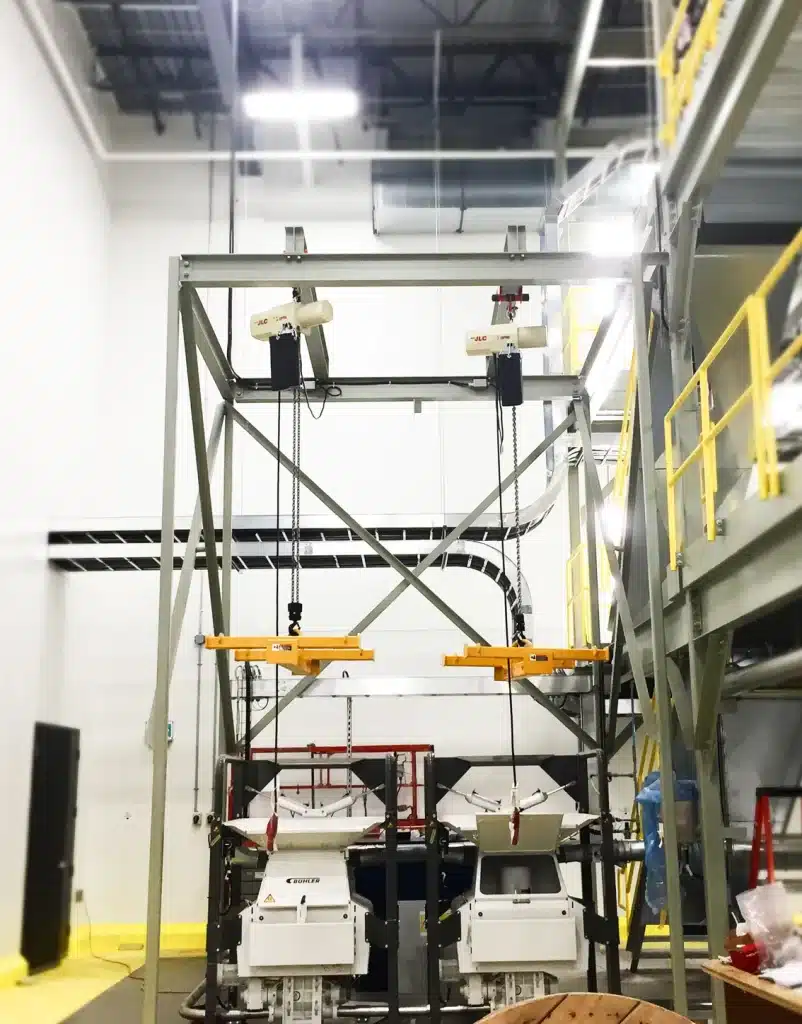
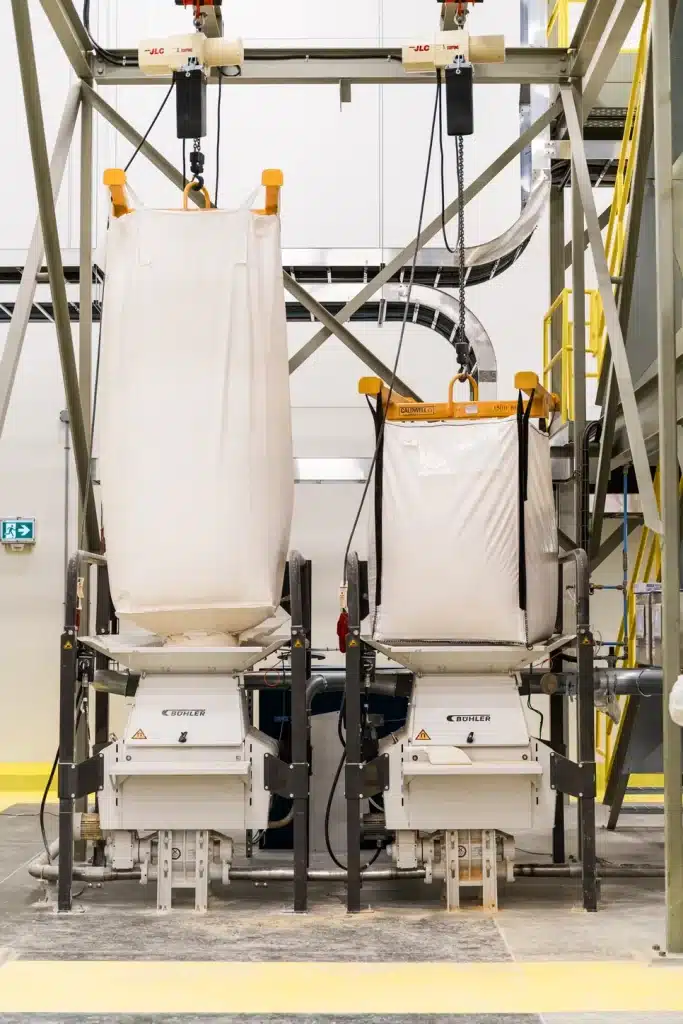
When the raw plant material arrives at the facility, it is delivered in bulk bags that can easily weigh upwards of 1000kgs each. These bags need to be lifted and placed above the repository so they can be emptied into the ingredient transfer system.

Firstly, Kristian supplied and installed two 1500kg Coffing JLC electric chain hoists, armed with 15’ of lift, to the existing frame above the hoppers. The Coffing JLC electric chain hoist is built for heavy-duty demands with a multiple disc motor brake, overload clutch, and H4 duty rating. With a line capacity of producing 4500 tonnes of protein per year, Kristian determined the JLC was the obvious hoist choice for this application.

Secondly, each hoist was fitted with a below-the-hook attachment called a bulk container lifting beam. These 36” lifting beams are constructed of smooth tubing, ensuring no sharp edges, and a low-headroom design constructed specifically for factory processes.

The bulk bag corner straps are then connected to the four endpoints of the beam, allowing for a safe and even lift above the hoppers.

As of 2021, Lovingly Made Ingredients already has room to expand their facility with several more production lines in the works. With the plant-based meat alternative market expected to be worth 140 billion dollars by 2029, growing their Calgary presence is definitely not a pea-brained idea.

Welcome to Calgary, Lovingly Made!

Dixxon at Kristian: Built for Work. Styled for Life.

When it comes to workwear, most people settle for “good enough.” But anyone who’s slipped into a Dixxon flannel knows there’s nothing “good enough” about it — it’s built different. At Kristian Electric, we’ve added DIXXON to our shelves to give welders, crane techs,...

Miller Build with Blue Is Back for 2026 — And It’s Bigger, Smarter, and Built for Real‑World Welding

Alright, let’s be real for a second. Winter is usually the season where welding projects slow down, budgets tighten up, and everyone starts putting off equipment upgrades. That’s exactly why Miller Build with Blue exists — and Build with Blue 2026 is shaping up to be...

Overhead Crane Service & Sales in Alberta & Saskatchewan | Kristian Electric

Authorized Hoist & Crane Service Depot — Calgary, Edmonton & Saskatoon Kristian Electric Ltd. is a Canadian leader in overhead crane service, hoist repair, CSA-compliant inspections, and crane system sales. With full-service branches in Calgary, Edmonton, and...

Feel The Heat – 4 Applications that Benefit from Induction Heating

Feel The Heat – 4 Applications that Benefit from Induction Heating

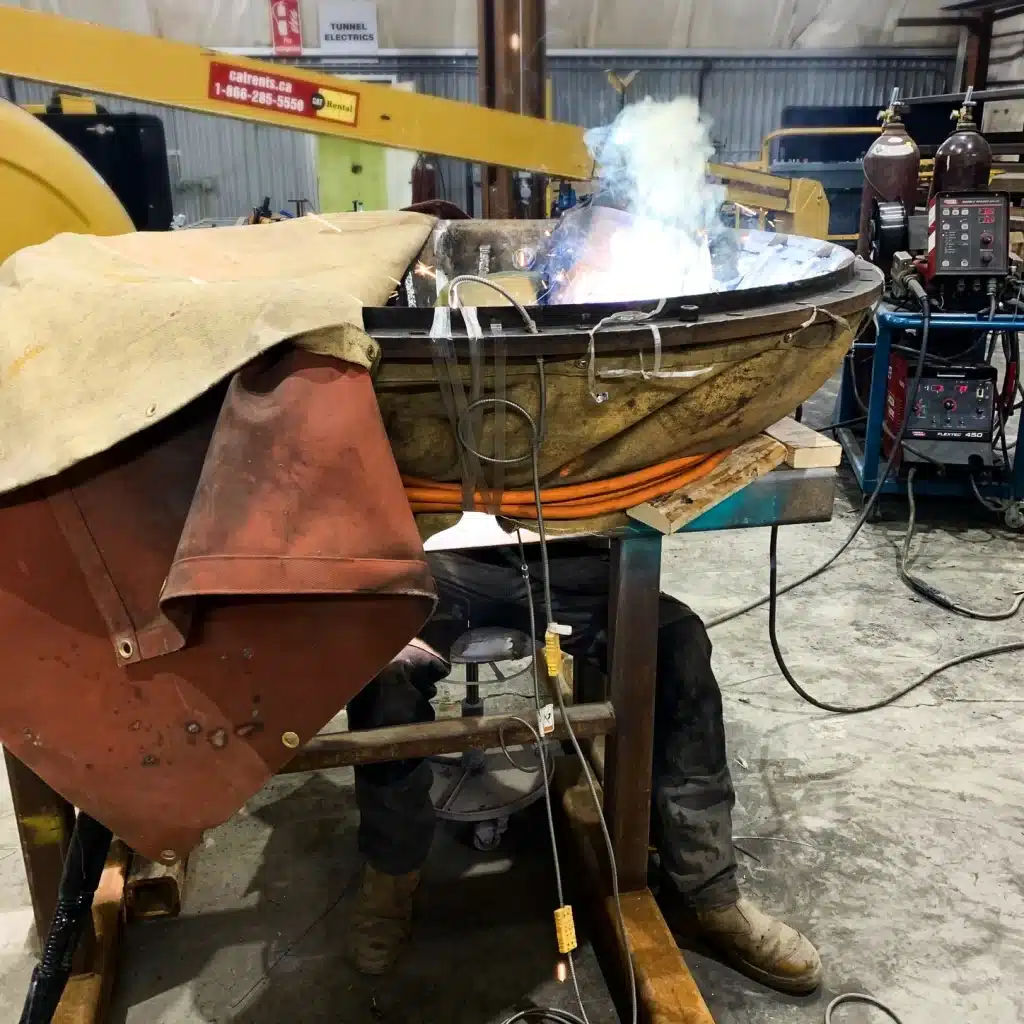
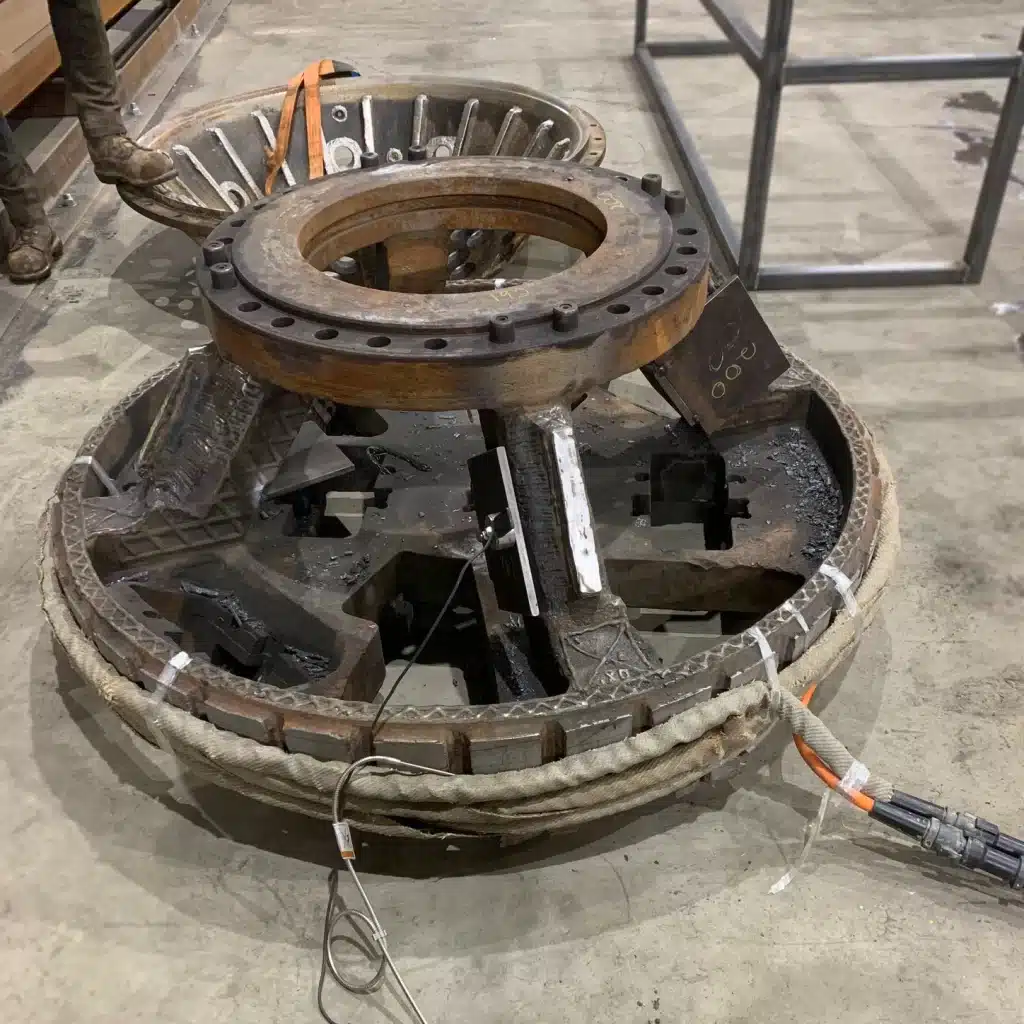
The Miller Proheat Induction Heating system utilizes inverter technology, similar to their welding equipment, to convert alternating 60hertz per second to kilohertz per second. This high-frequency alternating current, applied to ferrous metal, creates localized electrical currents called “eddy currents”. The circulating eddy currents flow against the metal’s resistance, thus heating the metal from the inside out.

Since the introduction of the Miller ProHeat induction system in the mid-2000s, induction heating has become a go-to choice in the industry to improve productivity. Applications that would typically require hours to heat can be done in minutes with the Proheat system.

Here are four industrial applications that will benefit greatly from the use of induction heating.


1. Preheat and Post-Heat of Welds

Welding preheat is done to reduce issues such as cracking and stress corrosion and to aid the parent and welding material in blending. Heating the area around a welding joint to a temperature under 350°F vastly reduces the cooling rate of the weld and moisture.

Post weld heating is done for similar purposes as preheating, however, at much higher temperatures (1150°F-1300°F) This returns the grain structure of the parent material and welded material to a normalized state.

Both post and pre-heat have traditionally been achieved with open flame, resistance heating, and convection ovens. However, these processes tend to cause inconsistent temperatures, untimely results, and require cumbersome labour. Induction heating allows for quick set-up (only minutes) and results between 4 to 12 hours, including ramp up and cool downtime. Along with steady and even heat disbursement, an induction system can be customized to the work itself, with the flexibility to heat many different sizes and shapes of metal.

2. Hydrogen Bake-Out


When the welding process is complete, residual stresses in the material can be left behind. Hydrogen cracking, (also known as delayed cracking, cold cracking, hydrogen-assisted cracking, hydrogen-induced cracking, and hydrogen embrittlement to name a few), can occur in a weld immediately or up to 72 hours after welding is completed. This is caused by atomic hydrogen dissolving into the steel. If there is enough concentration of these hydrogen atoms, the stress will reduce the metals threshold and cracks may begin to spread.

Hydrogen bake-out is achieved by elevating the material temperature to allow the hydrogen to diffuse out of the metal. This process is commonly attempted with open flame, which can be quite inconsistent and unsafe. One of the biggest issues with flame, especially when utilized in more northern climates, is that its biggest by-product is water vapour. This vapour can contribute greatly to the hydrogen build-up in the steel itself, making it a somewhat futile effort. With the Proheat induction method, there is no flame. The metal is uniformly heated from the outside to the specific, predetermined temperature and held there for as long as required.

3. Coating Removal


Occasionally, steel pipes and metal structures need to have their outer protective coatings removed. This is commonly done to allow for servicing, repairs, and maintenance of the metal beneath.

Though traditionally achieved with the use of a torch, or blasting with sand or walnuts, these processes tend to be hazardous, time-consuming, and make for difficult cleanup.

Induction generates heat within the coated metal, not to the coating itself, this allows for quick debonding of the coating from the steel substrate up to 90 percent faster than alternative methods. This process can remove coatings such as epoxies, urethanes, lead paint, fire-retardant coatings as well as glued, vulcanized, and chlorinated rubbers. Rather than being pulverized, the coating peels easily off, allowing for easy clean-up of debris.

4. Shrink fit Application or Removal by expansion


Thermal expansion is the tendency of matter to alter its shape, volume, and density in response to a change in temperature. This principle is put into practice to expand and shrink metal objects to create a fastening between two tight-fitting parts, also known as an interference fit.

Some alternatives rely on force to achieve a tight fit, however, by applying heat, the housing can expand just enough to allow for easy removal or insertion of the part with minimal force. Infrared heat and torches are commonly used to achieve this result, though these can affect the surrounding material and workspace. Induction heat is localized only to the part to be altered, making the work environment safer and more comfortable.

Click here to learn more about induction heating.

Dixxon at Kristian: Built for Work. Styled for Life.

When it comes to workwear, most people settle for “good enough.” But anyone who’s slipped into a Dixxon flannel knows there’s nothing “good enough” about it — it’s built different. At Kristian Electric, we’ve added DIXXON to our shelves to give welders, crane techs,...

Miller Build with Blue Is Back for 2026 — And It’s Bigger, Smarter, and Built for Real‑World Welding

Alright, let’s be real for a second. Winter is usually the season where welding projects slow down, budgets tighten up, and everyone starts putting off equipment upgrades. That’s exactly why Miller Build with Blue exists — and Build with Blue 2026 is shaping up to be...

Overhead Crane Service & Sales in Alberta & Saskatchewan | Kristian Electric

Authorized Hoist & Crane Service Depot — Calgary, Edmonton & Saskatoon Kristian Electric Ltd. is a Canadian leader in overhead crane service, hoist repair, CSA-compliant inspections, and crane system sales. With full-service branches in Calgary, Edmonton, and...

Ask the Crane Tech: 10 Ways to Prolong the Life of Your Crane

Ask the Crane Tech: 10 Ways to Prolong the Life of Your Crane

Have you ever wondered why you have so many problems with your crane? After over a decade servicing cranes, I’ve seen it all. Frequent crane issues can be caused by age, use (or perhaps abuse) of the crane, and even environmental factors. Establishing good practices with your overhead crane goes a long way; allowing you to increase your production by reducing downtime, service call volume, and repair bills.

Perhaps the best thing you can do for your cranes is to have your operators successfully complete a certified Crane Operator Training course. Crane Operator Training provides your operators more knowledge about the crane and an increased awareness while running your equipment. A proper crane operator training course serves to educate and correct some of the poor practices of novice operators; reducing incidents that could damage the crane and actions that accelerate component wear.

It may be easy to gloss over the importance of taking a few minutes to complete a pre-use check on the crane at the beginning of a shift or before the first use of the crane on each shift. Numerous issues can be caught on a pre-use inspection and dealt with immediately before they become problems. Completing a pre-use check may allow you to catch a malfunction in the crane before it breaks down with a load stuck in the air. An issue picked up on a pre-use inspection could be a quick, inexpensive repair now, before it becomes a lengthy and expensive repair after your valuable load falls to the floor.

Regular maintenance on your crane keeps your equipment in good condition for long, reliable production. Replacing oil before it gets too old, dirty, or contaminated will help reduce damage to the gearboxes. Periodic cleaning and adjustment of the brakes will prevent breakdowns due to drifting loads and motors running through the brakes causing them to wear out very quickly. Properly scheduled inspections can catch component wear or damage that can be repaired during an opportune window before it becomes a larger problem impeding your production schedule.


Now seems as good a time as any to get into the do-nots.

Side loading causes the wire rope or load chain to rub along the guide, causing wear and damage. It will result in replacing parts much quicker, accelerated wear on the wire rope or load chain, or even outright damage to the wire rope in the form of kinks or broken wires. Side-loading can also dislodge the trolley, allowing unexpected motion or even a swinging load.

Dragging a load with your crane will damage and/or prematurely wear your equipment. Dragging loads with your crane causes the same problems as side-loading along with the possibility of dislodging the hoist and trolley right off the bridge and down to the floor.

Over my career, I have seen many, many operators just mash a function button all the way down, jogging the crane with frequent short bursts of motion in high speed. As AC motors get a very large burst of current when they initially start, jogging causes a large amount of these bursts in a short period of time, generating large amounts of heat in the motor. Excessive use of this technique can cause not only motor damage – resulting in lengthy downtime and expensive repairs – but can even trip the motors thermal overload protection; stopping the crane completely and generating a service call

So what is the proper technique? When you approach the target in high speed, then switch to low speed when near the target (unless the equipment is single speed of course). Once you are very close to the target, jog the crane in LOW speed if necessary, to complete your task.

Whether your hoist is on a push/pull system or a jib crane, pulling your hoist by the pendant will inevitably result in the pendant drop cable pulling out of either the pendant or the hoist. Always get in the practice of pulling your hoist around by the hook or the load. You can also attach a tag line to the hoist or to the end of the jib beam and use that to move the equipment.

All operators should pay attention when they are moving the cranes around; not just at eye level, but above as well. Watch for the equipment nearing its end of travel — reaching this point stops the trolley or the bridge but it does not stop the wheels. The wheels will just keep spinning, wearing the treads and rubbing divots into the rails. Eventually, these divots will need to be filled because when they get deep enough the wheels will not be able to get out of them. Suddenly stopping an overhead crane when reaching end of travel at speed can also impart significant swing to the load; never a desirable outcome.

Your crane’s service life will also improve if you ensure your operators know the specifics of the equipment they are using and monitoring.

Hoist Specifics Example

Say your chain hoist does not have a lower limit switch, but your daily pre-use inspection requests a “Lower Limit” check. Checking the lower limit repeatedly in this circumstance will cause the hoist to run through the load limit clutch. Over time, the clutch will wear and the hoist capacity will be reduced.

Crane Specifics Example

Do your cranes have an anti-collision system installed? If not, you should ensure your operators pay greater attention while approaching other cranes. Two cranes colliding in high speed may result in damage to the structure and/or electrical components.

Building Specifics Example

Are your operators aware of the location of the heaters in the building? Parking the crane under a heater for a significant amount of time could melt the electrical cables, cook the gearbox oil, or even damage the motors.

The great outdoors is always rough on overhead cranes. Rain causes rust which can weaken the structure over time. Water can get into the gearboxes and contaminate the oil. Wet brakes can seize up when they dry. Many of the issues caused by rain can be prevented by covering the brakes and gearboxes on cranes that go outside.

Cold weather, especially here in Canada, can freeze the oil and cause it to gum up and stop coating the gears. Heaters can be installed on the gearboxes to maintain the oil’s viscosity.


Extreme cold can also cause frost to build up on the power conductors. Frost can then build up between the conductors and the contact shoes, isolating the crane from power. If this is a frequent issue you see, investing in special wire-brush contact shoes (self-cleaning contact shoes) will clean off the conductors to prevent the buildup of frost and other elements.


Exposure to the elements can also dry off the lubrication on the wire rope and drum, resulting in chattering or even damage to the rope guide. If your crane spends a great deal of time outside, I recommend more frequent applications of grease and oil.


But when it comes to protecting your crane from the weather, I recommend doing whatever possible to keep your crane inside. If parking your crane inside overnight is not an option, even covering your crane at night will go a long way towards preventing many weather-related issues.

 
Throughout this article, I’ve highlighted several things you can do to get more life out of your cranes. Some are simple solutions that can be easily and cheaply implemented; some are things that will cost you a little money now but will undoubtedly save you a lot of money later. Putting these strategies to work for you will give you a more reliable crane that lasts longer, improving production and reducing downtime. After all, that’s what we all want, isn’t it?
 

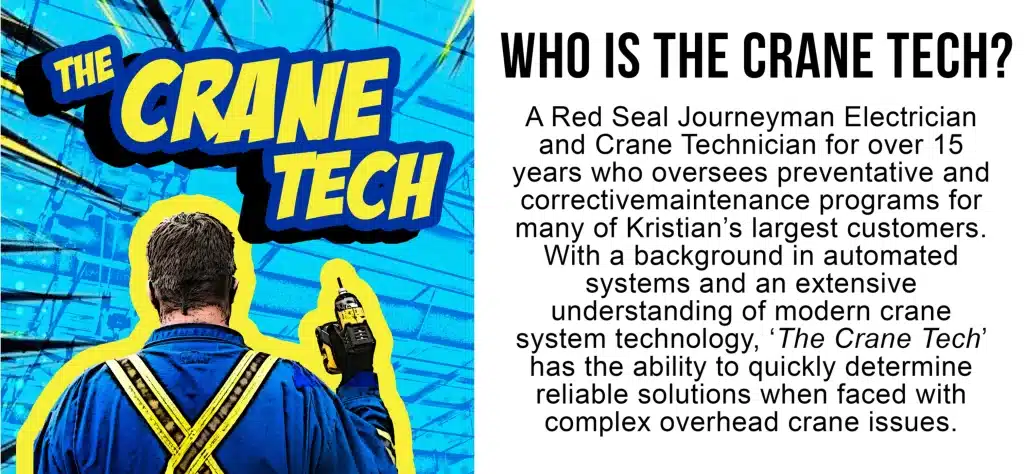
The Crane Tech
 

Dixxon at Kristian: Built for Work. Styled for Life.

When it comes to workwear, most people settle for “good enough.” But anyone who’s slipped into a Dixxon flannel knows there’s nothing “good enough” about it — it’s built different. At Kristian Electric, we’ve added DIXXON to our shelves to give welders, crane techs,...

Miller Build with Blue Is Back for 2026 — And It’s Bigger, Smarter, and Built for Real‑World Welding

Alright, let’s be real for a second. Winter is usually the season where welding projects slow down, budgets tighten up, and everyone starts putting off equipment upgrades. That’s exactly why Miller Build with Blue exists — and Build with Blue 2026 is shaping up to be...

Overhead Crane Service & Sales in Alberta & Saskatchewan | Kristian Electric

Authorized Hoist & Crane Service Depot — Calgary, Edmonton & Saskatoon Kristian Electric Ltd. is a Canadian leader in overhead crane service, hoist repair, CSA-compliant inspections, and crane system sales. With full-service branches in Calgary, Edmonton, and...